
Table of contents
- Anti silp film faced plywood specifications
- What anti silp film faced plywood means in specification terms
- Standard panel sizes and dimensional tolerances
- Thickness specifications and load relevance
- Core material specifications
- Anti-slip film specifications
- Glue and bonding specifications
- Edge sealing specifications
- Performance-related specifications
- Typical applications linked to specifications
- FAQ
- Conclusion
Anti silp film faced plywood specifications
Buyers often treat anti silp film faced plywood as a single product, but real performance depends on a long list of specifications. Thickness, core construction, film type, glue system, and edge sealing all shape how a panel behaves on a job site. When you understand these specifications, you avoid safety risks, early failure, and unnecessary cost.
This article explains anti silp film faced plywood specifications in practical terms. It focuses on what contractors, rental companies, and project buyers actually need to verify before placing an order. The content uses active, field-oriented language and reflects real sourcing and site conditions.
What anti silp film faced plywood means in specification terms
Anti silp film faced plywood (also widely written as anti slip film faced plywood) uses a textured phenolic film on at least one surface. Manufacturers emboss patterns such as wire mesh, hexagon, or grid into the film to increase friction. The goal is simple: provide safer footing on platforms, scaffolding boards, ramps, and temporary floors.
A complete specification defines more than surface texture. It also describes the panel’s structure, strength, moisture resistance, and dimensional consistency. Without clear specifications, two panels labeled “anti slip” can perform very differently on the same site.
Standard panel sizes and dimensional tolerances
Manufacturers supply anti silp film faced plywood in several standard sizes to match scaffolding systems and formwork modules. Buyers should always confirm not only nominal size, but also allowable tolerance.
| Nominal size | Metric equivalent | Common applications |
|---|---|---|
| 1220 × 2440 mm | 4 ft × 8 ft | General construction, platforms, temporary flooring |
| 1250 × 2500 mm | — | European formwork and scaffold systems |
| 610 × 2500 mm | — | Scaffolding boards and narrow walkways |
| Custom sizes | As specified | Rental fleets and project-specific layouts |
Reliable suppliers control length and width tolerance tightly to ensure safe installation. Excessive size variation creates gaps, uneven bearing, and unstable walking surfaces.
Thickness specifications and load relevance
Thickness plays a direct role in load capacity, stiffness, and service life. Anti silp film faced plywood often supports foot traffic, equipment movement, and material storage, so buyers should select thickness based on span and expected load.
| Thickness | Typical use | Notes |
|---|---|---|
| 12 mm | Light-duty platforms | Short spans only; limited load capacity |
| 15 mm | Temporary walkways | Common for light scaffold access |
| 18 mm | Scaffolding boards, site decks | Balanced strength and weight |
| 21 mm | Heavy-duty platforms | Better stiffness for longer spans |
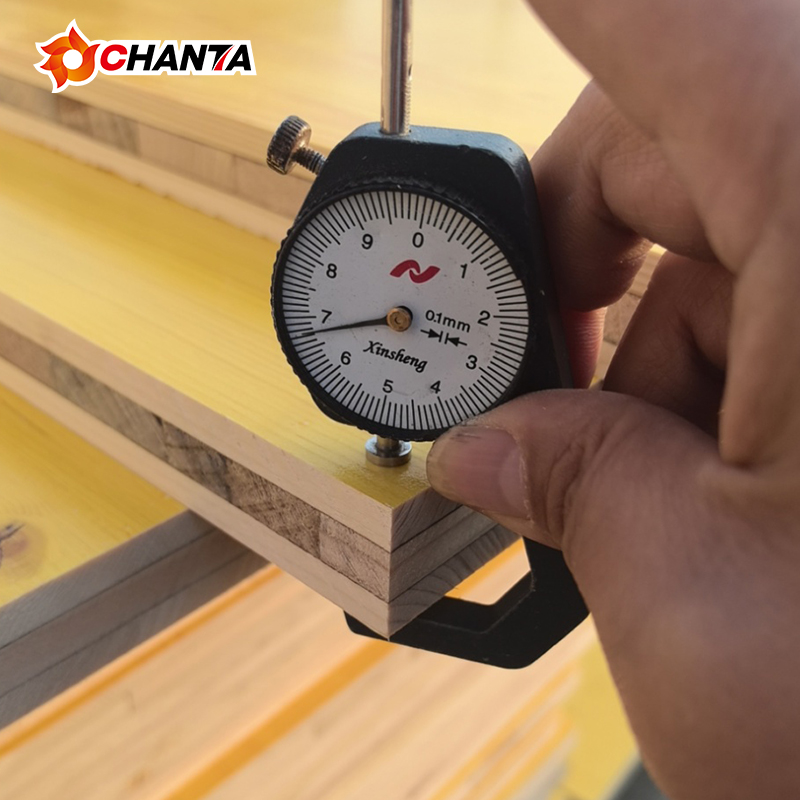
Buyers should always check thickness tolerance across the sheet. Inconsistent thickness causes rocking, uneven bearing, and premature film cracking.
Core material specifications
The core determines most of the panel’s structural behavior. Anti silp film faced plywood uses several core options, each with different cost and performance profiles.
Common core types
- Hardwood core – higher density, better load capacity, longer reuse cycles
- Poplar core – lighter weight, lower cost, reduced strength
- Mixed hardwood core – balanced performance and pricing
- Birch core – premium strength and stability in demanding environments
A proper specification also defines veneer thickness consistency and void control. Large core voids weaken the panel and reduce edge strength, especially in wet conditions.
Anti-slip film specifications
The anti-slip film forms the working surface of the panel. Film quality directly affects traction, abrasion resistance, and cleaning effort.
Film characteristics to specify
- Film type: phenolic resin impregnated paper
- Surface pattern: wire mesh, hexagon, or grid embossing
- Film weight: typically 120–220 g/m² depending on durability target
- Face configuration: single-side anti-slip or one anti-slip + one smooth face
Higher film weight improves wear resistance but increases cost. Buyers should match film grade to expected traffic and reuse cycles rather than defaulting to the highest number.
Glue and bonding specifications
Glue performance defines how well the panel resists moisture and temperature changes. Anti silp film faced plywood often works in outdoor or semi-exposed conditions, so buyers should specify exterior-grade bonding.
- Exterior-grade glue for wet construction environments
- Consistent glue spread to avoid internal weak points
- Controlled hot pressing to achieve uniform bonding
Glue quality matters more than marketing labels. A panel with good film but weak bonding will fail early once water reaches the core.
Edge sealing specifications
Edges act as the most vulnerable part of any plywood panel. Anti silp film faced plywood specifications should always include edge protection requirements.
- Sealed edges with waterproof paint or sealant
- Multiple coats for heavy-duty or rental use
- Uniform coverage without exposed veneers
Strong edge sealing slows water ingress and reduces swelling, delamination, and early rejection on site.
Performance-related specifications
Buyers often ask for performance data rather than construction details. While exact values depend on thickness and core, specifications should address these areas clearly.
- Slip resistance: textured film improves grip under wet and dusty conditions
- Load behavior: thickness and core determine allowable span and deflection
- Reuse cycles: film wear, bonding quality, and handling control service life
- Water resistance: glue system and edge sealing govern wet performance
Anti silp film faced plywood does not automatically mean “high strength.” Buyers must align thickness, core, and application to achieve safe performance.
Typical applications linked to specifications
- Scaffolding boards: 18–21 mm thickness, hardwood or mixed core, single-side anti-slip
- Temporary platforms: 18 mm thickness, dual-face option for flexibility
- Access ramps: high-grip film pattern and reinforced edge sealing
- Rental inventory: higher film weight and stricter tolerance control
FAQ
Is “anti silp” a different product from “anti slip”?
No. Both terms usually describe the same anti-slip surface concept. Buyers often type “anti silp” as a spelling variation. A proper specification should describe film pattern and performance rather than rely on the name.
Does anti silp film faced plywood meet safety standards automatically?
No. Surface texture improves grip, but overall safety depends on thickness, span, support design, and installation. Project managers should verify specifications against local safety rules.
Can I use anti silp film faced plywood for formwork?
Yes, when the panel includes a smooth reverse face. Crews should always place the smooth face against concrete to maintain finish quality.
Which specification affects service life the most?
Edge sealing and bonding quality usually control service life more than film texture. Water damage starts at unprotected edges and spreads inward.
Conclusion
Anti silp film faced plywood specifications define real-world performance. Size, thickness, core material, film type, glue system, and edge sealing work together as one system. When buyers specify these elements clearly, they improve safety, extend reuse cycles, and control long-term cost.








1 Comment