
Table of contents
- Confirm Core Material and Structure
- Verify Glue Type and Bonding Strength
- Evaluate Film Quality and Surface Performance
- Check Thickness and Dimensional Accuracy
- Inspect Edge Sealing and Protection
- Evaluate Reuse Performance Expectations
- Review Supplier Reliability and Production Consistency
- Compare Price Against Total Value
- Final Checklist Before Placing an Order
Buying film faced plywood for concrete formwork is not just about comparing prices. Many buyers experience problems such as inconsistent quality, short reuse cycles, or unexpected failures because they overlook key technical details before placing an order.
A structured checklist helps contractors, importers, and distributors evaluate suppliers and products more effectively. Instead of relying on surface appearance or general specifications, buyers should verify critical factors that directly influence performance.
This film faced plywood buyer checklist covers the most important points to review before purchasing, helping you reduce risk and improve long-term value.
Confirm Core Material and Structure
The internal core determines the strength, durability, and reuse performance of film faced plywood. Even if the surface film looks good, a weak core will lead to early failure.
Buyers should always verify what type of core material is used and how the veneers are assembled.
Check Core Species
Poplar core panels offer lighter weight and lower cost, while hardwood core panels provide better strength and longer reuse cycles.
Inspect Veneer Arrangement
Well-constructed plywood shows evenly layered veneers without gaps. Irregular layers indicate weak structural integrity.
Verify Glue Type and Bonding Strength
Glue quality is critical for durability, especially in wet concrete environments. Film faced plywood should use WBP (Water Boil Proof) glue to maintain bonding strength during repeated use.
Panels with poor adhesive quality often delaminate after only a few cycles.
Ask for Glue Specification
Reliable suppliers provide clear information about adhesive type and bonding standards.
Check for Delamination Risk
Examine panel edges for signs of separation or swelling, which may indicate weak bonding.
Evaluate Film Quality and Surface Performance
The phenolic film surface protects plywood from abrasion and moisture. High-quality film improves durability and ensures smooth concrete finishes.
Surface appearance alone is not enough. Buyers should assess both visual quality and film performance.
Check Surface Smoothness
The film should be uniform, without bubbles, cracks, or wrinkles.
Verify Film Weight and Resin Content
Heavier resin film generally provides better wear resistance and longer service life.
Check Thickness and Dimensional Accuracy
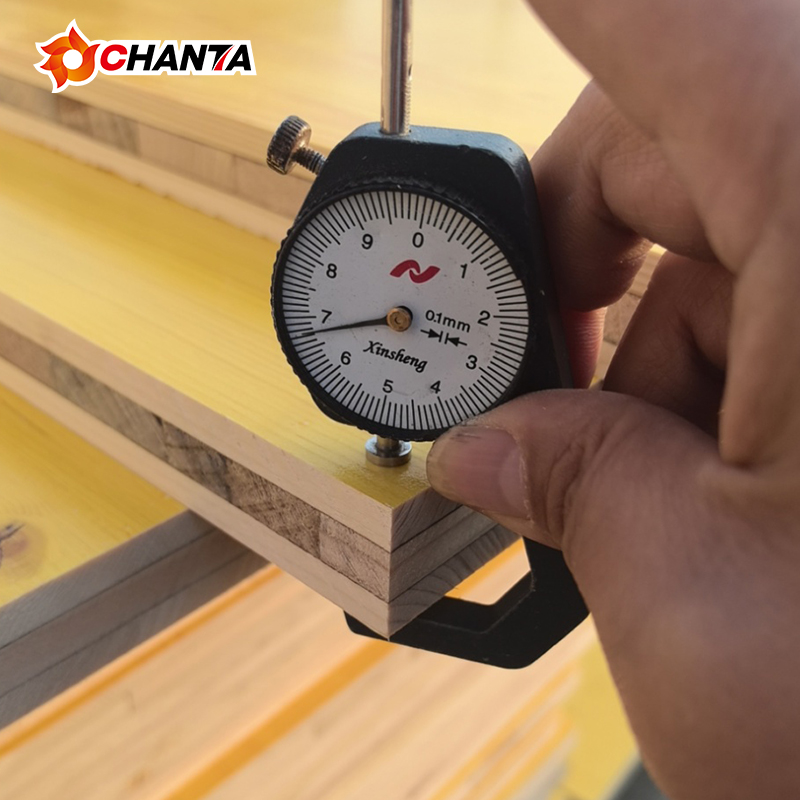
Thickness affects structural strength and formwork stability. Inconsistent thickness can cause uneven concrete surfaces and installation problems.
Buyers should ensure that thickness tolerance meets project requirements.
Confirm Standard Thickness
Common options include 12mm, 15mm, and 18mm, with 18mm being the most widely used for heavy-duty formwork.
Verify Thickness Consistency
Panels should maintain uniform thickness across the entire sheet.
Inspect Edge Sealing and Protection
Edges are the most vulnerable part of film faced plywood. Proper sealing prevents moisture from entering the core and extending panel lifespan.
Poor edge protection leads to swelling and early failure.
Check Edge Paint Quality
Edges should be evenly sealed with waterproof coating.
Look for Physical Damage
Cracked or chipped edges reduce structural integrity.
Evaluate Reuse Performance Expectations
Reuse cycles depend on panel quality, project conditions, and handling practices. Buyers should not rely on unrealistic claims.
Understanding expected reuse performance helps calculate cost per use.
Ask for Realistic Reuse Range
Typical ranges vary from 5 to 20 uses depending on grade and core material.
Consider Project Conditions
Heavy construction and harsh environments reduce reuse cycles.
Review Supplier Reliability and Production Consistency
Choosing the right supplier is essential for long-term success. Consistent production ensures stable performance across multiple orders.
Experienced manufacturers maintain strict quality control throughout the production process.
For example, manufacturers such as CHANTA focus on stable raw material sourcing, controlled pressing conditions, and consistent film application to ensure reliable performance.
Check Production Capacity
Large-scale factories with modern equipment often provide more consistent products.
Request Sample and Batch Consistency
Compare samples with bulk orders to ensure consistency.
Compare Price Against Total Value
The lowest price does not always provide the best value. Buyers should evaluate film faced plywood based on cost per use rather than initial purchase price.
Higher-quality panels may cost more upfront but reduce replacement frequency and labor costs.
Calculate Cost Per Use
Divide panel price by expected reuse cycles to compare true value.
Avoid Short-Term Cost Focus
Cheap panels often lead to higher long-term expenses due to early failure.
Final Checklist Before Placing an Order
Before confirming your purchase, make sure you have verified the following:
- Core material and veneer structure
- Glue type and bonding quality
- Film surface and resin content
- Thickness and dimensional accuracy
- Edge sealing and protection
- Expected reuse performance
- Supplier reliability and consistency
Conclusion
A structured buyer checklist helps reduce risk when purchasing film faced plywood. By evaluating core construction, glue type, film quality, thickness, and supplier reliability, buyers can make informed decisions and avoid common problems.
Taking the time to verify these factors ensures better performance, longer reuse cycles, and improved cost efficiency in concrete formwork projects.
Articles You May Be Interested In








1 Comment